CAP September 2026 release
An overview of what the September 2026 release of CAP brings.
The September 2026 release of CAP is out. This is the first minor release following the major release upgrade in June of this year, and brings CAP Node.js to 10.1 and CAP Java to 5.1.
It's "only" a minor release, but goodness me there's a lot of great stuff. Let me take you through some of the highlights, which are split into different categories.
CAP Native AI
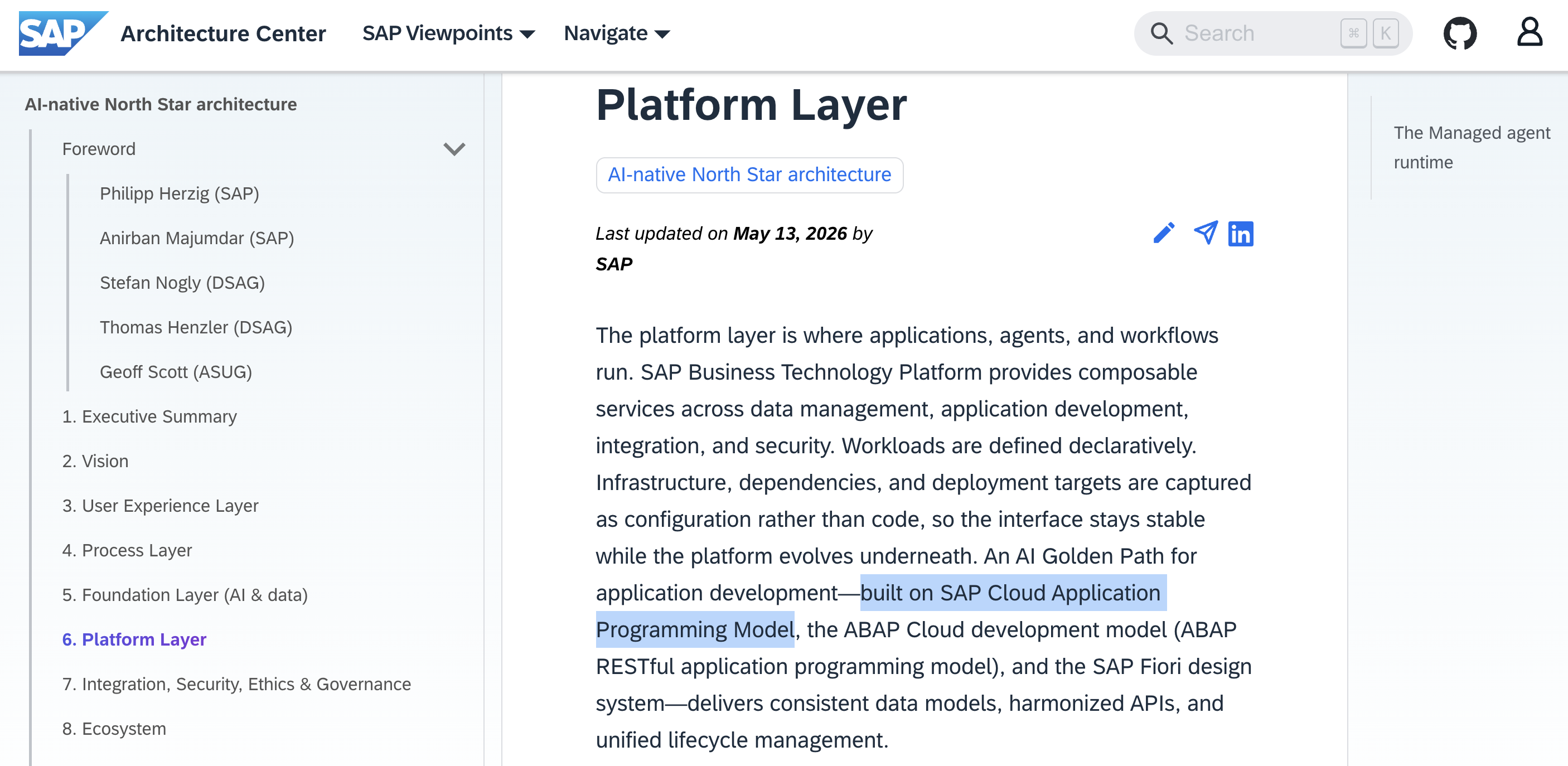
First there's the CAP Native AI category, which has come about mostly because there's been so much work in this area. After all, CAP is the foundation for much of our AI business solutions and central to our AI North Star architecture:
A new guide
It's been almost a full-time job keeping track of all the progress, and keeping our corresponding research and learning in line with what's being developed. Luckily there's an early incarnation of a new top-level guide called Native AI, which covers all the important topics:
-
Vector embeddings: natively supported by HANA, an essential mechanism for AI-powered searching, matching and recommendations (particularly useful in UIs).
-
MCP: a fundamental building block of today's agentic era, enabling agents to embellish their context and actually effect things in the wider world. The MCP adapter plugin is now GA, by the way!
-
A2A: like MCP, agent support in CAP is a mere annotation away, plus optional Markdown based skills and guardrails in this case. What's more, in addition to the mocking we're familiar with, we get a mocked LLM with the agents plugin plus a super useful UI for interaction. All out of the box, following CAP's classic developer-first approach. The agents plugin is in Gamma status right now.
You may wish to check out our current Hands-on SAP Dev live stream series on CAP in the age of AI which covers these topics and more.
There's even a section of this new guide that's all about integration with Joule; in the spirit of the release early, release often philosophy popularised by the one and only Eric S. Raymond in his essay The Cathedral and the Bazaar, it's a very early and raw release, just hinting at the structure and content to come.
A scenario to try out all the AI concepts
Going back to talk of agents, it's sometimes hard to conjure up a realistic-enough scenario to kick the tyres with, but CAP has you covered too with the XTravels Sample for AI; it's not too simple as to be underwhelming, but not overly dry and boring either. It allows us to explore lots of different concepts and protocols, such as subagency, delegation, A2A and MCP, as well as the more classic ideas of reuse, data APIs and more.

Much love for vector embeddings
While some features might come to CAP Node.js first, and then to CAP Java, or vice versa, things are generally eventually consistent. CAP-native support for vector embeddings is one such feature, already supported for CAP Java but now also for CAP Node.js.
The Vector Embeddings guide has also had an overhaul, which is where we can find the details of how to get embeddings working locally with SQLite which doesn't have native support for them. In a classic "magic made simple" way, the CAP team have done a serious amount of heavy lifting and configuration for us to emulate what's required. Kudos to the team.
Keeping our AI overlords happy
In my not so humble opinion, the CAP documentation, affectionately and unofficially known as "Capire", stands out as a great example of what we should all be striving for with respect to sharing knowledge, know-how and best practices.
The audience for this knowledge is not just limited to us humans, far from it. One way that we make great strides forward in agentic computing is to make sure our agents know what to do, and how to do it ... in the best possible way.
Agent skills are useful, for sure, but in the same way that we have stop-gap measures to cover the last mile between the scope of any given language model pre-training and the reality today, skills cover the delta between what we consider now as best practice, and what was the previous status quo in that regard.
To that end, it's more important than ever that documentation remains accurate and concise, and tells us - humans and LLMs alike - what to do and how to do it best, and in a way that is readable (and token-friendly too).
And so the team has made machine-friendly representations of the resource that is Capire, with the content and a sitemap in what is the lingua franca between humans and their AI overlords - Markdown.

For more on resources & representations, see 'Conneg' and the duality of weblogs and also Coffeeshop screencast: HTTP conneg, resource representations and JSON.
The CDS language family
The next category within which we find updates in the September 2026 release is the CDS language family. Briefly:
-
Boolean expressions are now wrapped in a
CASE WHENconstruct for HANA SQL, as bare predicates aren't permitted in the list of elements for selection. -
It's now possible to extend views that already have a conditional clause; the new condition is combined with
AND. -
When using nested inline projections, we can now use the
keykeyword; typically this is needed when the key elements need to be extended to inside the projection to provide the uniqueness required.
These are minor but really nice improvements to the life of a domain expert or modeller, allowing us more flexibility and power as we continue to shift left, avoid bloat and moving parts, and - above all - fight the lazy agentic pattern of verbose and unnecessary generation of almost-immediate technical debt.
CAP Runtimes
Following the same category pattern as in the release notes, we now come to the runtimes category, for Node.js and Java.
In fact, before we bifurcate,
there's a feature in this minor release that applies to both runtimes, relating
to fuzzy search, a fault-tolerant search feature of SAP HANA Cloud. Results are
now sorted by match score, unless that order is overridden by an $orderby
parameter in the query.
Node.js
Beyond the pretty amazing new feature that provides support for vector embeddings with SQLite in a Node.js context, there's also a further move towards an ever more lighter weight of dependencies. This is especially relevant in today's world of software supply chain attacks, and an ever smaller surface area is always desirable.
For more on this, see Daniel Hutzel's keynote at reCAP this year.

To this end, and powered by the Node-native Fetch API that was embraced in the CAP Node.js runtime earlier this year, and which has allowed the team to shed a whole load of dependencies already, the reliance on the SAP Cloud SDK is also further reduced, down to a subset of destination types.
Basically, there are some authentication types such as OnPremise that are not
supported yet - but for all the others, the Fetch-API plus CAP Node.js is all
we need.
Java
There are quite a few updates for the Java runtime, including:
-
Support for the OData v4.01 JSON batch request format; v4.01 is the latest version in the OData family of standards and the move from
multipart/mixedis welcome, as far as I'm concerned :-)To learn more about OData, you might want to take a look at the OData Deep Dive mission.
-
When building a query, we can use the
excluding()method to avoid having to specify a long list of the elements wanted, instead specifying a short list of the elements that are not wanted. -
When building for hierarchy views (such as in Fiori Tree Tables) the
@cds.default.orderannotation can be used to specify the desired sort order of siblings. -
The CDS Maven plugin used for CDS-related build steps has undergone some optimisations, for faster builds, a fast mode for the
watchgoal, and static implementation generation for faster reflection-free access.
Tools
Did someone say tools and the CLI? I'm here for that. First, shell completion, which has been around for a while, but has had a complete overhaul in this September 2026 release. The upshot is that it's much faster, more responsive and puts less stress on your shell as it works. Pretty awesome. Shell completion is available for Bash, Zsh, fish ... and even PowerShell!
Completions are available for the commands, options and then (where relevant) files and directories - completion for these is via standard shell mechanisms, which is great.
And it's nice to see IntelliJ getting lots of love - version 3 of the CDS plugin for that IDE now supports CDS 10, and has some nice new formatting options too.
Plugins
We're almost done, but we can't forget all the work that goes into the CAP plugins, can we? While they're not part of the core (the clue's in the name, right?) they can be essential components in our projects, and many of them are maintained by the CAP team themselves.
Here's a list of plugins that have had updates in this release:
-
The ORD plugin - which is now also open source 🎉 - now supports generating Open Resource Discovery definitions for lots of protocols, including OData and MCP.
-
The Attachments plugin now supports single attachments, instead of the standard list construct. There are also some major release properties that you need to pay attention to, in both runtimes.
-
The Notifications plugin for the Node.js runtime has been overhauled, and for Java there's an initial Alpha release too.
-
Last but not least, there's a new n8n1 plugin, also in Alpha, for both runtimes. This plugin lets us trigger n8n workflows directly from CAP.
Wrapping up
For a minor release, that's pretty spectacular, I'd say. You can check out all the release notes, which themselves have links to further reading, in the usual place, and it's also worth keeping an eye on the 2026 Changelog too.
Happy learning!
Footnotes
- The name "n8n" is a meta-contraction of "node[auto]mation".