Legacy and foundation - the enduring Unix tech stack
Musing on how the Unix technologies endure and remain the foundation for much of today's tech.
The word "legacy" is wielded by various folks, and in many cases it's in a pejorative sense. I don't think they always appreciate the full context.
Consider aspects of the enduring Unix legacy that our tech stacks still rely on today. Beyond such fundamental building blocks and concepts such as environment variables, which even now make the cloud work (service keys and bindings are made available to apps that way), we are embracing the terminal as the natural best fit for human-agent interaction.
And while collaborating with agents, we see that the constructs they employ to Get Things Done ... are command line tools in the context of the shell1, strung together in classic pipelines. While we still work in a predominantly text-based world, this is a natural fit.
As a nod to this, I snuck a one-liner into one of our tutorials for SAP TechEd 2026 in Berlin: Connect a CAP-level agent to AI Core. A step in this tutorial involved retrieving a specific ZIP file from a GitHub repo, unpacking it, formatting the JSON that was contained within into a single bite-sized chunk, and assigning it as a value for an environment variable.
As well as providing the step-by-step manual instructions, I couldn't resist providing a one-shot shell incantation:
d=$(mktemp -d -p /tmp/) \
  && git clone --quiet https://github.com/SAP-samples/teched2026-sk-gen "$d" \
  && find "$d/keys/" -name 'sk-*.zip' \
  | sort -n -t- -k2 \
    | tail -1 \
    | xargs unzip -o \
  && export AICORE_SERVICE_KEY="$(jq -c . sk.json)"
The future is terminal, indeed!
I was reminded of all this while catching up with Jon Udell's archive of posts, one of which is “What is the terminal?”, wherein he draws a stark contrast between (non-developer) folks who don't even really know what a terminal is, and how we developers and our agents remain steeped in the glory that is the command line. Heck, I know some folks who have traditionally chosen IDEs over command lines and editors, but have recently pivoted to the terminal to embrace TUI based agent harnesses like Claude Code and OpenCode.
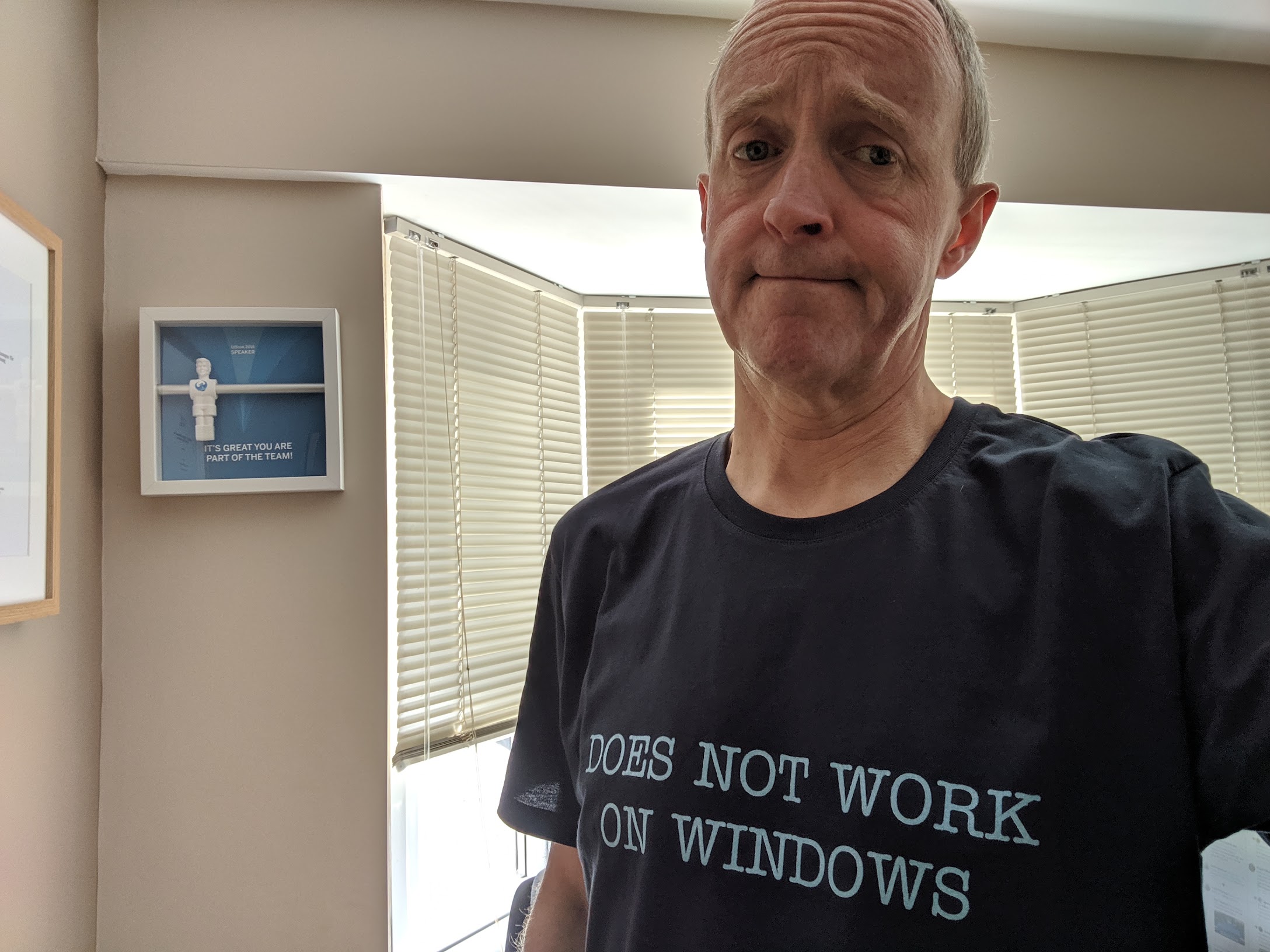
I couldn't help smile at the story that Jon used to start the post, a story about another one of my heroes2 Larry Wall - who had been unable to get the Windows-based machine on the speaker podium to behave. The story reminded me I should dig out this t-shirt, and wear it more.
Footnotes
-
And I'm happy to note that Bash seems to be still the most popular.
-
I used to attend and indeed speak at The Perl Conference, and was a member of London Perl Mongers back in the day.
- ← Previous
GraphQL and Conway's Law