Book Overflow and two architectural patterns in CAP
In this short post I note a couple of software architecture patterns that were mentioned in a recent Book Overflow episode, patterns that are clear and present in CAP.
Book Overflow is "a long-form discussion podcast for software engineers" and one of the shows to which I'm subscribed.
The recent episode 118 is one in the series where Carter and Nathan discuss the book Learning Domain-Driven Design: Aligning Software Architecture and Business Strategy by Vlad Khononov.
I listened to this episode today and found that, as usual, the two go into great depth and draw on their thoughtfulness and experience to tease out details and connect the dots for us listeners.
Covered in their discussions were a couple of patterns that resonated with me:
- Ports And Adapters
- Transactional Outbox
Both these patterns live and breathe strongly within CAP, from a philosophical standpoint but also from a place that drives the fundamental design of the framework and how it manifests for us developers. So I thought it would be worth both highlighting this episode, series, and podcast, and also drawing the dots between the patterns and where they are in CAP.
Ports and adapters
The Ports And Adapters pattern is another name for Hexagonal Architecture, brought into this world and popularised by Alistair Cockburn. It's the ultimate approach to making agnosticism and abstraction first class players in system design.
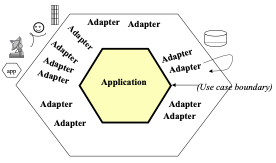
(Nathan playfully observed that the hexagon isn't really used to the max, with only four sides used in the illustration. I may be misremembering, but I think Alistair might have picked the hexagon as it was different from other boxy shapes available in a classic software diagramming template he had to hand, plus the "extra" sides lend themselves to further expansion by folks using the diagram to express their own usage of the pattern.)
Of course, we know that Hexagonal Architecture is a core concept in CAP, one that supports CAP's agnostic-by-design approach to pretty much everything. It also is a fundamental enabler of the CAP developer experience - grow as you go for rapid prototyping with mocks followed by a seamless transition to production grade services when appropriate.
Transactional outbox
The Transactional Outbox pattern is one that we see reminders of while
developing, with the built-in outbox table. This pattern allows the
coordination of a typical enterprise scenario where data needs to be updated
and an event needs to be sent to a remote system.
The requirement to have both (synchronous and asynchronous) parts as a transactional unit presents challenges, but by deferring the actual delivery of the event to a separate service, the two parts can coalesce and indeed be treated as a unit that collectively either works or doesn't.
Facilitating this is an "outbox" for events, which is at the heart of this pattern, and which CAP has had for a few years now.
Further reading
The Microservices Architecture website is a great resource and has a page on the Transactional Outbox pattern. For an overview of Ports And Adapters, Alistair's original article is still well worth the read.
For more on CAP design and philosophy, see the blog posts (and videos) in The Art and Science of CAP series with Daniel Hutzel himself.